


A packet of seeds can produce a reassuring final count and still give uneven seedlings. Another packet may begin more quickly but finish with the same number of successes. These observations describe different parts of seed performance, so a useful home-growing record should preserve both the final count and the timing.
A small test is a way to learn about a particular sample under recorded conditions. It is not an official seed certificate or a guaranteed forecast of the garden. The most helpful result is a clear account that another person could understand without seeing the tray.
Choose the question before counting
Start with a question such as whether two packets reach a similar final germination percentage under the same conditions. That question requires the starting number and the final number meeting a defined endpoint. Asking which packet begins sooner requires observations along the way.
Seed vigour is a broader idea involving performance across relevant conditions. The International Seed Testing Association’s vigour committee connects its work with emergence, uniformity and storage potential. A single kitchen-table observation cannot replace the validated, species-specific methods used in professional testing.
Give your record a modest name: home emergence comparison, for example. The title then communicates what you actually observed rather than borrowing the authority of a laboratory test that used a different procedure.
Define what counts as a success
A visible root, an emerged shoot and a normally developed seedling are different endpoints. Choose one for the main count and describe it plainly. You can record the others in separate columns, but do not change the definition halfway through because one packet looks disappointing.
For a constructed example, imagine that the endpoint is a visible emerging root. Sixteen of twenty seeds eventually meet it. The observed proportion is sixteen divided by twenty, multiplied by one hundred: eighty percent. That result does not say that sixteen plants will survive transplanting or reach harvest.
If a root emerges and the seedling later deteriorates, retain both observations. Erasing the early event makes the timing record inaccurate; calling it a lasting success makes the later condition disappear. Separate columns solve the problem without forcing one label to describe the whole life of the seed.
Make the comparison fair
Label the species, variety, packet, storage history and starting date. Follow relevant instructions for that seed type rather than imposing one temperature or light requirement on every plant. The University of Minnesota’s indoor seed-starting guidance explains why moisture, growing-medium temperature and light conditions need attention.
Place comparison groups where they experience similar conditions. If one sits above a heater while another rests against cold glass, packet identity is mixed with location. A difference would then have at least two plausible explanations.
Record a change in conditions when it happens. A dry corner, displaced cover or accidental spill is relevant information, not an embarrassment to remove from the notebook. It can explain why a result is hard to interpret.
Keep daily and cumulative counts separate
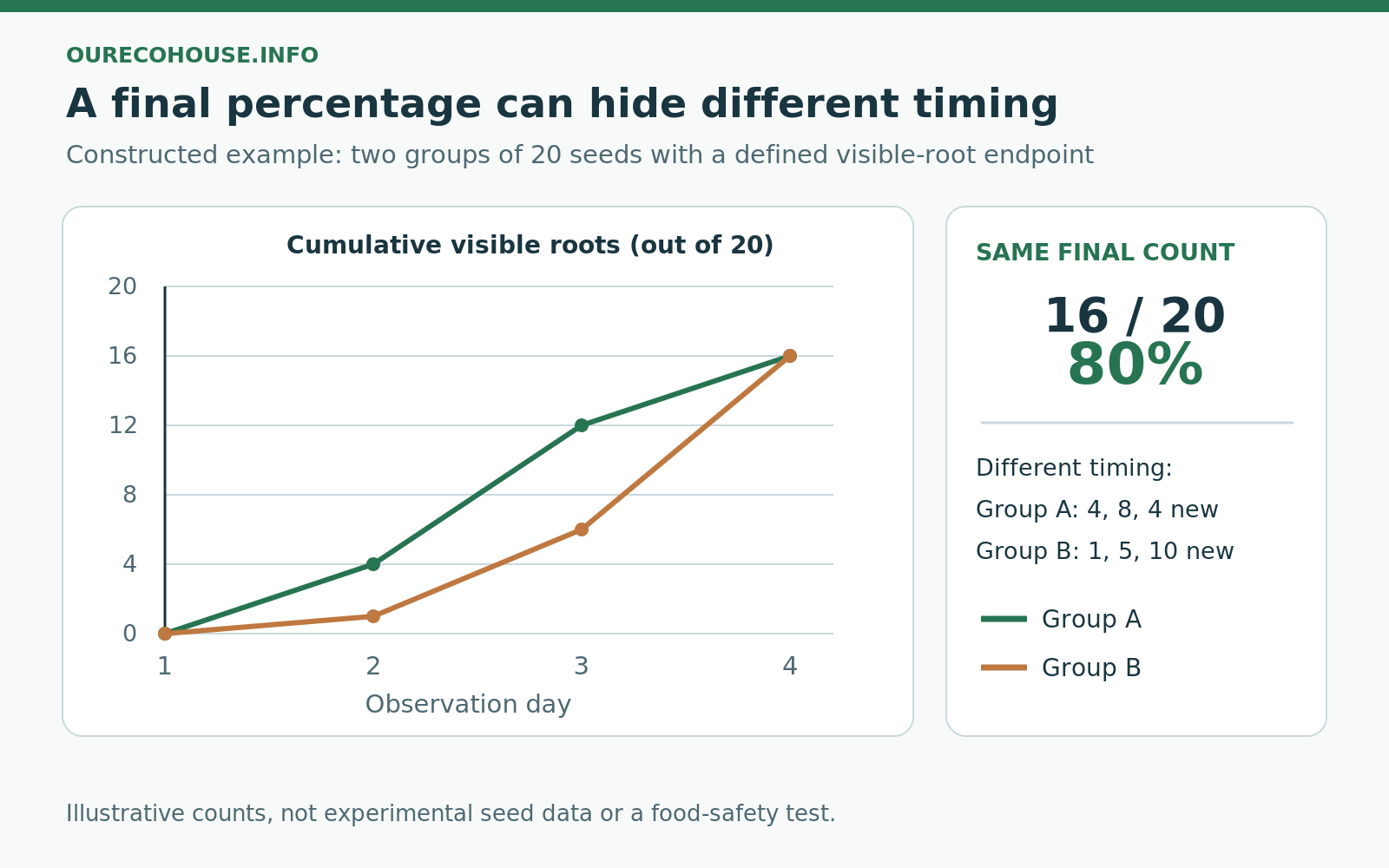
Suppose twenty seeds produce four new visible roots on day two, eight on day three and four on day four. The daily counts are four, eight and four. The cumulative counts are four, twelve and sixteen. Adding the cumulative column would count earlier seeds repeatedly.
Now compare a second fictional group with one, five and ten new roots on those days. It also reaches sixteen. Both groups finish at eighty percent, yet the second group reaches the endpoint later. A final percentage alone hides that difference.
A simple plot makes the distinction visible. Put observation day on the horizontal axis and cumulative successes on the vertical axis. Keep the denominator in the caption. A curve based on twenty seeds should not be presented as though it came from hundreds.
Use timing summaries carefully
The first emerging seed is easy to notice but can be an unrepresentative outlier. A group with one early success and many late ones may look fast if you report only its first event. The full cumulative record provides a more balanced description.
You can calculate a mean observation time among the seeds that reached your endpoint by multiplying each day by its new-event count, adding those products and dividing by the total successes. For the first fictional group, the result is three days.
State that the average concerns successful seeds. The four seeds without an observed event have not acquired an imaginary day value. Giving them a value of zero would make the average earlier, which is the opposite of what their missing event represents.
Respect the size of the sample
With twenty seeds, one additional success changes the observed percentage by five percentage points. A result of eighty percent versus eighty-five percent can therefore differ by only one seed. The precision of the displayed percentage should not exceed the information in the count.
Using two small groups from the same packet can show how much results vary within your setup. Keep their labels and results separate before calculating a combined proportion. If one group performs differently, inspect conditions and the counting rule before assuming the packet contains two distinct biological populations.
A sample also needs a fair selection method. Choosing only the largest, most attractive seeds answers a question about that selected group. It does not necessarily describe the complete packet.
Do not turn a missing event into a diagnosis
A seed that has not reached the endpoint by the last observation may be dead, dormant, delayed or poorly matched to the test conditions. A home count alone does not reliably distinguish those possibilities. Record what was seen and the observation window.
Similarly, visible mould does not identify its species or establish why a seed failed. Avoid opening a biological investigation by assuming that every white thread, discoloured surface or slow seed has the same cause.
Keep seed testing separate from growing sprouts for food. This comparison does not assess microbial safety or make its contents suitable to eat. Its purpose is to improve planting records and clarify the questions that need a different kind of evidence.
Use the record for a practical decision
A final note can be short: twenty seeds tested, sixteen reached the stated endpoint, most appeared on day three, and four had no observed event by the final check. Add any change in conditions and what you intend to compare next.
That record is more useful than simply writing good seeds or weak seeds. It preserves the difference between an observed event, its timing and later plant performance, which is the foundation for understanding more detailed studies of seed biology and plant defence.


